
The Odyssey
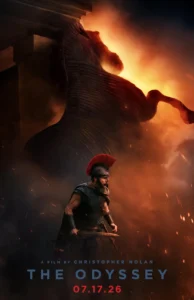
2026
Director: Christopher Nolan
Starring: Matt Damon, Anne Hathaway, Tom Holland, Robert Pattinson, John Leguizamo, Elliot Page, and more.
After the Trojan War, Odysseus faces a dangerous voyage back to Ithaca, meeting creatures like the Cyclops Polyphemus, Sirens, and Calypso along the way
Christopher Nolan has spent a lot of his career telling stories about men haunted by what they have lost. In The Odyssey, he finds maybe the oldest version of that story but gives it a surprisingly emotional new shape.
Matt Damon stars as Odysseus, the legendary king of Ithaca who spent ten years trying to make his way home following the Trojan War. Waiting for him is Penelope (Anne Hathaway), who refuses to give up hope that her husband is alive despite the growing pressure to choose another. Their son Telemachus (Tom Holland) shares that hope, even as Ithaca fills with opportunistic suitors eager to claim both Penelope and Odysseus’ throne. Robert Pattinson is particularly effective as the most calculating among them, a man more than willing to convince Penelope that her husband is never coming back.
But Odysseus remains very much alive, although his journey has left him battered physically and psychologically. When we find him under the spell of Calypso (Charlize Theron), his fractured memories become the gateway through which Nolan revisits the years that brought him there.
The structure the director used to play with time kept him from turning Homer’s epic into another elaborate Nolan puzzle. The chronology shifts and folds as Odysseus remembers his travels, but the basic story remains remarkably accessible. Rather than trying to outsmart an audience already familiar with the tale, Nolan seems more interested in discovering what the story means when filtered through his own preoccupations with guilt, memory, war and home.
His approach to the mythology is similarly restrained. This is unmistakably a world of monsters, sorcery and divine intervention, but Nolan rarely treats those elements with extravagant fantasy. Zendaya’s Athena appears periodically to guide Odysseus, while Samantha Morton brings an eerie severity to Circe. Even Circe’s transformation of Odysseus’ men into pigs is presented with an unsettling physicality rather than spectacle for spectacle’s sake. She was also perhaps my favorite secondary character in this film.
The Cyclops encounter is even more effective. Nolan strips the sequence down to its most primal elements, turning the confrontation into something close to a horror film. Odysseus is traditionally famous for his cleverness and his pride, but here the emphasis falls less on his boasting and more on the terrifying business of surviving the creature’s cave.
That sequence is hardly the movie’s only visual triumph. Shot entirely in 70mm IMAX, The Odyssey frequently looks enormous without losing its sense of human vulnerability. Ships seem impossibly small against the open sea, while battles become intimate, chaotic affairs. Some unfold almost entirely in darkness, with fire providing the only illumination as Ludwig Göransson’s score drives the tension higher.
The Trojan War material is especially impressive. Nolan stages the Trojan Horse and the fall of Troy not simply as heroic legend but as catastrophe. Odysseus may have engineered one of history’s most famous military deceptions, but victory brings him little satisfaction. What happened at Troy follows him long after he leaves its ruins.
That gives Damon some of the film’s strongest material. His Odysseus is weary, guarded and increasingly conscious of the human cost of his choices. Damon resists turning him into a grand mythological hero. Instead, he plays him as a man who has survived long enough to understand that survival itself does not absolve him.
There are obvious echoes of Oppenheimer in Nolan’s treatment of Troy. Once again, he is fascinated by a brilliant man whose ingenuity helps unleash destruction on a scale he can’t emotionally handle afterward. War changes Odysseus, but Nolan also suggests that Troy changed the world he hopes to return to.
Not everything in this enormous adaptation lands well. The Odyssey covers an extraordinary amount of material, and occasionally the film feels as though it is checking off famous episodes simply because audiences expect to see them. The encounters with Scylla and Charybdis, for example, are visually accomplished but comparatively rushed. And they were ones I was most looking forward to.
Other additions prove much more rewarding. Elliot Page appears as a Greek soldier whose fate becomes another burden Odysseus carries home with him, giving the story an unexpectedly intimate thread of remorse. Lupita Nyong’o makes a strong impression as a defiant Helen of Troy, while Himesh Patel brings warmth and steadiness to the role of Odysseus’ second-in-command. John Leguizamo is especially affecting as the Ithacan swineherd who has continued waiting for his king.
For all its monsters and battles, however, the movie ultimately belongs to the family at its center.
The final stretch is notably free of the elaborate narrative games often associated with Nolan. Instead, he allows the homecoming to unfold with unusual simplicity. Damon, Hathaway and Holland make Odysseus, Penelope and Telemachus feel less like mythological icons than three people damaged by years of separation who must discover whether returning home is the same thing as restoring what was lost.
It is here that The Odyssey becomes particularly revealing as a Christopher Nolan film.
Again and again throughout his career, Nolan has told stories about men trapped by memory, grief and an obsessive desire to recover something time stole from them. Odysseus may have been wrestling with those same forces thousands of years before Memento, Inception or Oppenheimer, but he fits naturally among Nolan’s complicated protagonists.
The difference is that this time, home still exists.
The Odyssey isn’t flawless. It is sprawling, occasionally rushed and inevitably selective in deciding which pieces of Homer’s epic deserve the most attention. And it’s very loud honestly. But at its best, it is spectacular without becoming hollow and emotionally resonant without abandoning Nolan’s cerebral instincts.
More importantly, it feels unexpectedly personal. Nolan has spent decades making movies about men struggling to return to a world they can no longer reach. With Odysseus, he finally gets to tell the story of a man crossing an impossible distance because somewhere beyond it, someone is still waiting for him.
Isy